Where a Backpack and a Sports Bra Fight Each Other, and How to Stop It
Quick Answer: A backpack strap and a bra strap both load the top of the trapezius, and stacking them concentrates pressure in a small area that has little padding over it. The fix is to move the backpack load off the shoulders — tighten the sternum strap, use a hip belt if there is one, shorten the straps so the pack sits high — and to choose a bra with wider, further-apart straps so the two are not sitting on the same line. Most shoulder pain here is a load placement problem, not a bra problem.
You got a good sports bra. It fits. The band does the work, the straps do not dig.
Then you put a loaded backpack on for a forty-minute commute and by Wednesday there is a specific sore spot on both shoulders.
Why does stacking two straps hurt more than one heavy one?
Because pressure is force divided by area, and stacking reduces the area without reducing the force.
A bra strap on its own distributes a modest load across its full width. A backpack strap on its own distributes a larger load across its width, which is usually greater. Put them on the same line and you have two loads concentrated into the overlapping region, which is narrower than either strap.
There is a second factor that makes this worse than the maths suggests. The bra strap is underneath, which means it takes the full compression of the backpack load pressed down onto a thin band. A thin strap under pressure behaves like an edge, and edges concentrate force further.
The anatomy matters too. The top of the shoulder — the upper trapezius, and the area where the strap sits — has relatively little soft tissue padding over bone, and there are nerves and blood vessels passing through the region. Sustained pressure there is what produces the aching, and occasionally tingling down the arm, that people describe.
For a fuller bust this is amplified, because bra straps are carrying more load to begin with if the band is not doing its job properly, and because the pack is often heavier for someone commuting with a laptop and a change of clothes.
How much of this is the backpack, not the bra?
Most of it, in most cases. This is worth establishing before spending money on a new bra.
A quick diagnostic: wear the bra for a full day without the backpack. If the shoulders are fine, the bra is fine and the pack is the problem. Almost everyone who tries this discovers it is the pack.
The four backpack adjustments that matter, in order:
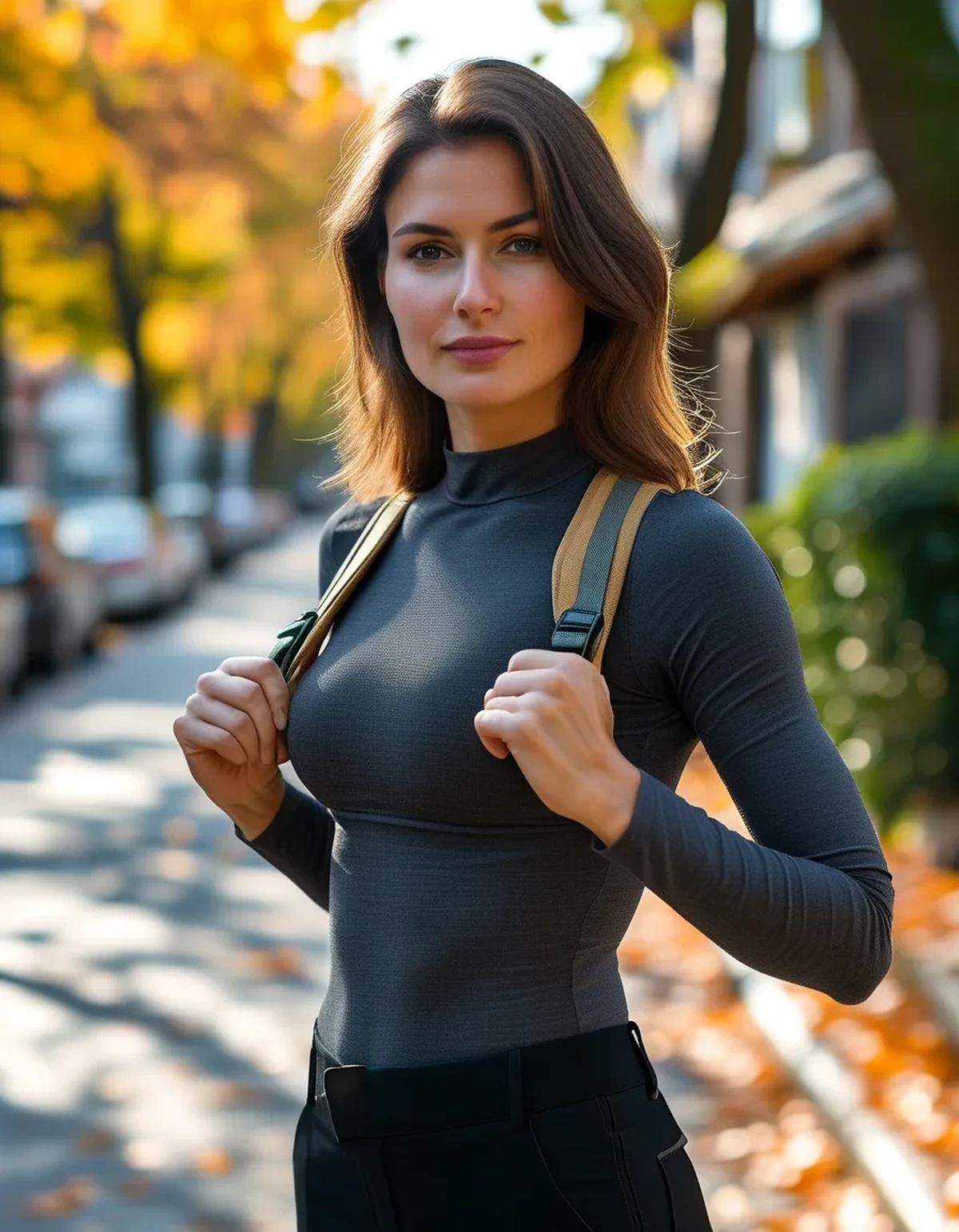
1. Shorten the straps so the pack sits high. A pack hanging low pulls backwards and down, which loads the shoulders and rotates them forward. The bottom of the pack should sit at roughly waist level, not at your hips. This is the single biggest change and it costs nothing.
2. Use the sternum strap. Most packs have one and most people never use it. It pulls the shoulder straps inward so they sit on a wider, flatter part of the shoulder rather than sliding toward the neck. Set it at about mid-sternum height — too high and it restricts breathing.
3. Use the hip belt if there is one. A hip belt transfers a substantial share of the load to the pelvis. On a properly fitted pack this can move most of the weight off the shoulders entirely. Even a light webbing belt helps.
4. Reduce the weight. Obvious, ignored. A laptop, a charger, a water bottle, a gym kit, and a book adds up quickly, and shoulder load scales directly with it.
One more: wide, padded straps genuinely help. A thin webbing strap on a cheap pack concentrates load in exactly the way you are trying to avoid.

What should you look for in a bra if you carry a pack daily?
Wide straps, set further apart, and a band that is genuinely doing the work.
Strap width. Wider straps spread the load. This matters more when something is pressing on top of them. Look for straps at least a couple of centimetres wide, and avoid thin racerback straps for daily pack-carrying — they concentrate load at the top of the shoulder specifically.
Strap position. Straps set wider apart sit further out on the shoulder, where there is more soft tissue and where a backpack strap is less likely to sit directly on top. A narrow-set strap and a narrow-set pack strap converge at the same point near the neck, which is the worst case.
Band tension. This is the one people get wrong. In a well-fitted bra the band carries the large majority of the support, and the straps carry relatively little. If your straps are digging in before the backpack is even involved, the band is too loose and has ridden up. The instinct is to tighten the straps, which increases shoulder load and makes the backpack problem substantially worse.
Test the band: you should be able to slide two fingers under it with some resistance, and it should sit level all the way around, not riding up at the back. If it rides up, go down a band size and up a cup size.
Racerback versus standard: racerback is excellent for support and poor for backpack compatibility, because it concentrates the strap load centrally, right where a pack strap crosses. A standard back with wide-set straps is usually more comfortable under a pack even if it is marginally less supportive.
5 Mistakes Everyone Makes With Bras and Backpacks
1. Tightening the bra straps to fix shoulder pain. This is the most common and the most counterproductive. Shoulder pain almost always means the band is not supporting properly. Tighter straps increase the load at exactly the point that hurts.
2. Carrying the pack on one shoulder. It feels easier for short distances and it loads one side with everything, including the twisting force. If you are going to do it, alternate sides deliberately every few minutes — but two straps is genuinely better.
3. Wearing a coat over both and assuming it helps. A coat adds a layer but it also adds friction and, if it is fitted, it can press the pack straps down harder. A slippery lining helps; a bulky one that shifts the straps outward does not.
4. Ignoring one-sided pain. Pain on one shoulder only usually means the pack is loaded unevenly, or one bra strap is adjusted shorter than the other. Both are trivially fixable and both are almost always the cause. This is the mistake that sends people to buy a new bra when the real fix took thirty seconds.
5. Putting up with numbness or tingling. Aching from pressure is uncomfortable and generally resolves. Numbness, tingling, or weakness down the arm is a different signal and is worth getting checked by a doctor rather than adjusting straps and hoping. This is general information, not medical advice.
FAQ: Backpack and Sports Bra Questions, Answered
Is a crossbody bag better than a backpack?
For a light load, possibly — it moves the weight off the shoulder top. For anything heavy, no. A crossbody concentrates all the load on one shoulder and introduces a twisting force through the spine, which is worse for the back even if it is better for the specific sore spot. Two straps, properly adjusted, is the better answer.
Does a sports bra with a back closure help?
Sometimes, mainly because back-closure styles often have more adjustability, so you can get the band genuinely right. The closure itself sits at mid-back, which is below where a pack strap crosses, so it rarely creates a pressure point. Some people find the hooks uncomfortable under a pack — it is worth checking with the actual pack rather than assuming.
What about on longer walks or hikes?
Everything above applies more strongly. For a full day, prioritise the hip belt above everything else, use the sternum strap, and consider a bra without hooks or seams under the strap path. Chafing becomes a factor over hours in a way it is not over forty minutes.
How long should shoulder soreness take to settle?
Pressure soreness generally eases within a day of removing the load. If it persists, if it is present without the pack, or if you have numbness, tingling, or weakness, see a doctor. This is general information, not medical advice.
TL;DR:
- Two straps on the same line concentrate pressure into a small, poorly padded area. It is a load placement problem.
- Diagnose first: wear the bra without the pack for a day. It is usually the pack.
- Fix the pack: shorten the straps so it sits high, use the sternum strap, use the hip belt, carry less.
- Choose wide, wide-set straps. Racerback supports well and is poor under a backpack.
- Never tighten the straps to fix shoulder pain — the band is what needs fixing.
- Numbness or tingling is not a strap problem. See a doctor.
Most of this is free and takes two minutes. This is general information, not medical advice.
See It in Motion
Seen here: UPF 50+ Short Sleeve Rashguard Swim Shirt — shop it on bubblelime.com
Keep Reading
This article is for general informational and styling purposes only. Fit, sizing, and product availability may vary.