Why Your Sports Bra Rides Up at the Band - and How to Stop It
Quick Answer: A sports bra band rides up because it is too loose around your ribcage, not because it is too short. The band should be the tightest part of the garment and carry most of the support; when it cannot grip, the straps take over and pull the whole band upward. The fix is usually going down a band size and up a cup size, not sizing up overall.
You reach overhead, and the band travels north with you. Every single time.

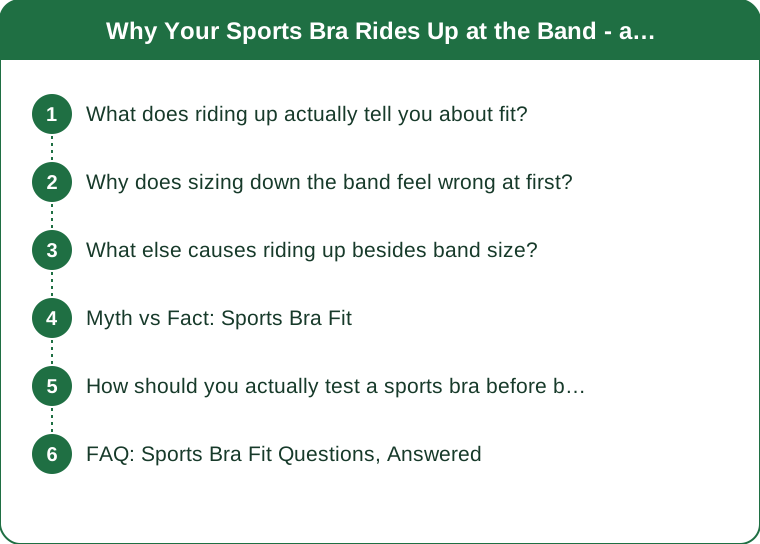
What does riding up actually tell you about fit?
It is one of the most diagnostic fit signals available, and it points in a consistent direction.
The band should do most of the support work. In a well-fitted bra - sports or otherwise - the band carries the large majority of the load, and the straps do relatively little. When the band is loose, that ratio inverts. The straps take the weight, and because straps pull upward from the shoulders, they drag the back of the band up with them.
So riding up is a loose-band symptom, and the instinctive response - loosening the straps - makes it worse, because it removes the only thing currently holding anything up.
Three checks that confirm it:
- The two-finger test. You should just be able to slide two fingers under the band and no more. Four fingers means it is too loose.
- The back line. The band should sit level and horizontal across your back. A band that curves upward at the back is loose, and this is visible in any photo.
- The strap-off test. Slip the straps down and lift your arms. A correctly fitted band stays put with no strap help at all for a moment. If it falls or climbs immediately, the band is the problem.
Why does sizing down the band feel wrong at first?
Because most people are wearing a band considerably looser than the one that fits, and calibration is set by habit.
A correctly fitted band feels firm. Noticeably so, at first - snug across the ribs, present, not something you forget about instantly. That is what support feels like, and after years in loose bands it registers as too tight for the first few wears.
The distinction that matters: firm and even is correct; digging, pinching, or restricting your breathing is not. You should be able to take a full deep breath without feeling constrained. If you cannot, it genuinely is too small - but a band that simply feels present is doing its job.
Sister sizing is the mechanism to use. If you go down a band size, go up a cup size to keep the cup volume the same. A 36C becomes a 34D. The cup has not got bigger - the same volume is expressed differently against a smaller band. This single adjustment resolves a very large share of riding-up complaints.
Note that new bands are meant to fit on the loosest hook, because elastic relaxes with wear. Buying a band that already needs the tightest hook gives you a few good months and then a year of a loose bra.
What else causes riding up besides band size?
Several other causes, in rough order of how often they are the real culprit.
Worn-out elastic. Sports bra elastic degrades faster than regular bra elastic because of sweat, heat, repeated stretching, and washing. A bra that fit fine last year may be genuinely finished. Roughly 30 to 40 wears is a realistic service life for high-intensity use before support starts to noticeably degrade.
Tumble drying. The single fastest way to kill elastic. Heat destroys elastane permanently and no amount of careful washing offsets it.
Fabric softener. Coats elastic fibres and reduces their recovery. Skip it entirely for anything with stretch.
Straps over-tightened. Cranking the straps to fix a loose band is the most common self-inflicted version of this problem. It transfers load to the shoulders, which causes both the riding up and the shoulder pain that usually accompanies it.
A band that is too narrow for the support level required. Wider bands distribute load better and grip more effectively. For higher-support needs, a narrow strip of elastic is working against physics.
Wrong style for the activity. Compression-only styles work up to a point; above that, encapsulation or a combination style holds position better. Riding up during running while staying put during yoga is a style problem, not a size problem.
And the practical one: putting it on wrong. Lean forward, settle everything into the cups, then stand and adjust the band down. A bra put on standing upright frequently starts the session already sitting high.

Myth vs Fact: Sports Bra Fit
Myth: If it rides up, you need a bigger size. Fact: Almost always the opposite for the band. Sizing up overall makes the band looser, which is the actual cause. Down a band, up a cup.
Myth: The straps provide the support. Fact: The band provides most of it. Straps are for positioning and a minority of the load. A bra where the straps are doing the work will produce shoulder and neck pain, which is one of the most common complaints in this whole category.
Myth: Tighter is always more supportive. Fact: Up to a point. Beyond correct fit you get restricted breathing, chafing and pressure marks without additional support. Correctly fitted beats tight.
Myth: Two sports bras layered gives you more support. Fact: It mostly gives you more compression and more chafing, and it flattens rather than supports. A single correctly fitted high-support bra outperforms two badly fitted ones, and the doubling habit is usually a sign that the primary bra does not fit.
Myth: Sports bras do not need replacing until they fall apart. Fact: Support degrades long before the fabric does. The garment can look fine and be functionally finished. If you cannot remember when you bought it, it is probably past it.
Myth: Your sports bra size matches your regular bra size. Fact: Frequently not, and it varies by brand and style. Compression styles, encapsulation styles and combination styles all fit differently on the same body.
How should you actually test a sports bra before buying it?
Six checks, in the changing room, in this order. It takes two minutes.
1. Put it on properly first. Lean forward, settle in, stand up, adjust the band down to sit level.
2. Check the band is horizontal. Turn sideways and look. Riding up at the back means too loose.
3. Two fingers under the band, at the back. No more, no less.
4. Jump. Genuinely jump, ten times. This is the test people skip and it is the only one that simulates the actual load. Movement should be minimal in all directions, not just vertical - side-to-side and figure-eight motion is what causes discomfort in higher-support needs.
5. Raise your arms fully overhead. The band should stay put. If it climbs, the band is loose - this is the exact test for the problem in question.
6. Run a finger around every edge. Look for gaping at the top of the cup, spillage over the top, digging under the arm, or fabric bunching. Gaping means too big in the cup; spillage means too small.
One extra check for anyone with a larger bust: look for a bra with adjustable straps, a proper hook-and-eye back closure rather than pull-over-head construction, and separate cups. Pull-over compression styles have a practical support ceiling, and past that point they compress rather than support, which is a different and less comfortable thing.
FAQ: Sports Bra Fit Questions, Answered
How tight should the band actually be?
Firm and even, with two fingers of room and no restriction on a deep breath. It should feel present. It should not leave deep marks or make you want to take it off.
How often should I replace a sports bra?
For regular high-intensity use, roughly every 6 to 12 months, or about 30 to 40 wears. The signal is loss of support, not visible wear.
Why does my bra fit at the start of a run and not by the end?
Elastic warms and relaxes slightly with body heat and sweat, and a band that is borderline at the start will be loose by mile three. That is a sign the band is already too loose cold.
Should I wear a regular bra under a sports bra?
No. It creates seam friction and neither garment fits properly. If your sports bra needs help, it is the wrong bra.
Is riding up ever normal?
A small amount of movement during high-impact activity happens even in a good bra. Travelling several inches, or needing readjustment mid-session, is not.
TL;DR:
- Riding up means the band is too loose, not too short - the straps are taking over and pulling it up
- Go down a band size and up a cup size to keep cup volume the same
- The band should carry most of the support and sit level and horizontal across the back
- Tumble drying and fabric softener kill sports bra elastic faster than anything else
- Jump ten times and raise your arms overhead before you buy anything
The band does the work. Everything else is positioning.
See It in Motion
Seen here: Racerback Tank Top - White — shop similar styles on bubblelime.com
Keep Reading
This article is for general informational and styling purposes only. Fit, sizing, and product availability may vary.